
Analysis
The Analysis command group provides tools for visualizing, documenting and evaluating PV layouts in Helios 3D. It includes marker schemes for arrays, posts, modules and surfaces, snapshot functions for converting temporary analysis graphics into printable AutoCAD objects, tools for post report filtering, array legends, cross section views and yield-related assessment functions.
Use this section when you want to check layout properties visually, prepare analysis graphics for drawings or reports, compare layout variants, or create supporting documentation for technical review and project communication.
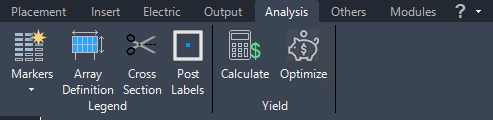
Command Group Legend
The Legend commands are mainly used after a layout has been created and should be reviewed, documented or prepared for output. Marker schemes help to highlight specific value ranges or object groups in the drawing. Some of these graphics are temporary display elements, while snapshots convert selected temporary hatches into standard AutoCAD objects that can be selected, printed and included in drawing documentation.
Marker Schemes
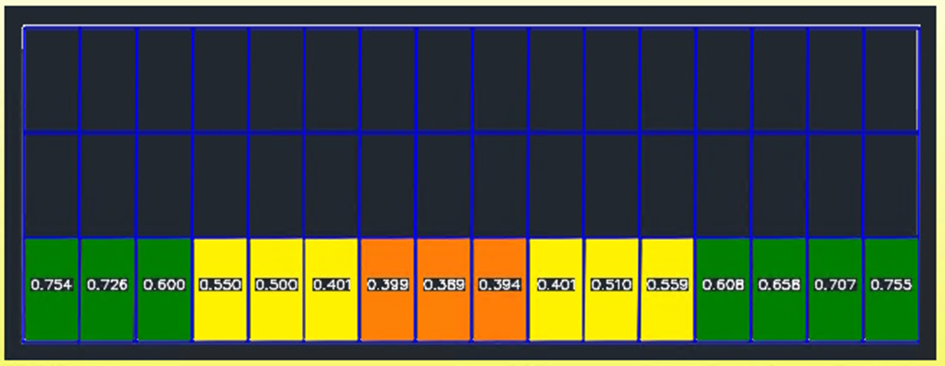
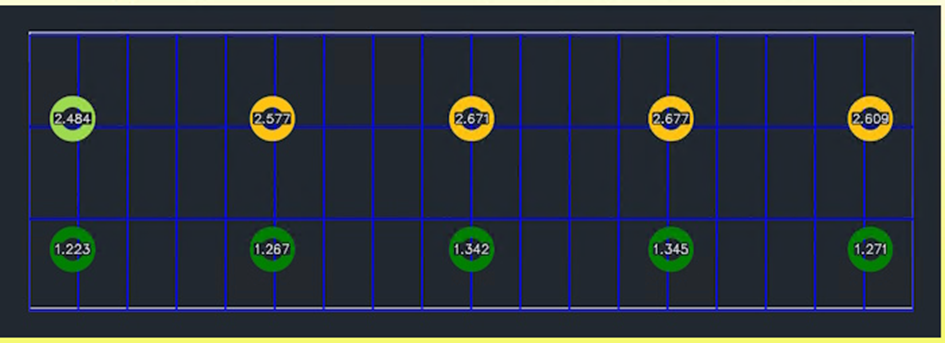
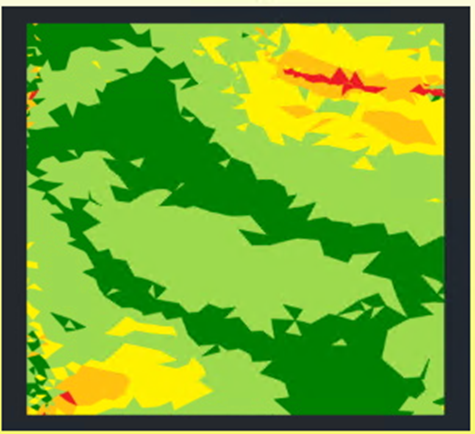
Marker schemes can be used to visually classify layout elements such as arrays, posts, modules or surfaces. Typical use cases include checking value ranges, identifying groups of objects, reviewing terrain-related or layout-related differences, and preparing visual feedback for planning decisions.
Not all marker displays are intended as permanent drawing content. If the visualization must be printed or transferred as part of a drawing, use the snapshot function to create standard AutoCAD hatch objects.
Functions for different marker schemes for arrays, posts, modules and surfaces. For each type, intervals can get defined with separate colors for temporary hatches or circles. The snapshot command will change displayed temporary hatches into standard AutoCAD objects.




Hide Markers

Hides all displayed markers.
Create snapshot
Use this command when temporary marker hatches should become permanent drawing objects. The created snapshot objects can be selected and printed like regular AutoCAD hatches. This is useful when analysis results must be included in layout drawings, review plans or exported documentation.
Important: Snapshot objects represent the marker display at the time of creation. If the layout or marker scheme changes later, the snapshot may no longer match the current project state and should be recreated.
Creates a snapshot from the displayed temporary hatches belonging to marker schemes. These get inserted as AutoCAD hatches, which are selectable and printable.
Delete snapshots

This command removes the snapshot objects that were created from marker schemes. It is useful for cleaning up the drawing before creating a new analysis snapshot or before finalizing a drawing without temporary analysis graphics.
Important: The page states that objects on the layer “H3D_Snaphost” are deleted. The spelling of this layer name should be editorially checked. If the correct layer name is “H3D_Snapshot”, the Help-Center text should be corrected.
Deletes all objects on the layer „H3D_Snaphost“.
Create post markers to filter report

Post markers allow a selected group of posts to be identified for reporting. When a post report is printed, the marked posts can be used as a filter so that only the relevant posts are included. This is useful for staged construction areas, selected terrain zones, quality checks or partial documentation of a project.
Opens the dialog for creating a post marker scheme for the selected fields. On printing a post report, you can choose to just include such marked posts.
Delete post markers for reports

Use this command to remove post markers that are no longer required for report filtering. This helps avoid outdated or unintended filters when creating new post reports.
Important: Before deleting post markers, check whether they are still required for the current report workflow or for communication with construction, surveying or quality control teams.
Deletes post markers from the drawing.
Insert Array Legend
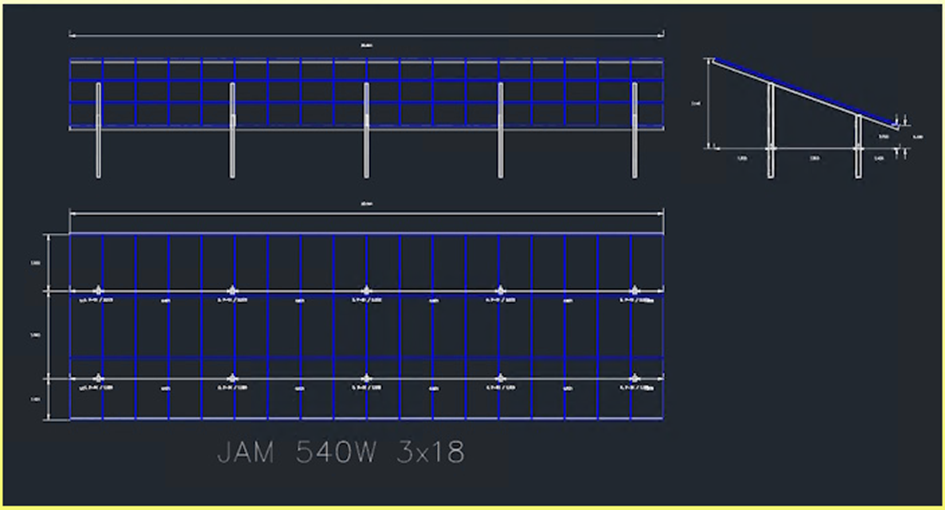
The array legend provides a compact graphical description of an array definition. It can include top, front and side views as well as relevant geometry dimensions. This helps users and project stakeholders understand the construction geometry of the selected array type directly in the drawing.
The function uses the dimensioning style “H3D_AL”. If the legend does not appear as expected, check whether the dimension style is available and whether the selected array definition contains the required geometry information.
Create Cross Section View
The Create Cross Section View command creates a graphical cross section through a selected part of the PV layout. Cross sections can be created along a row or perpendicular to several rows.
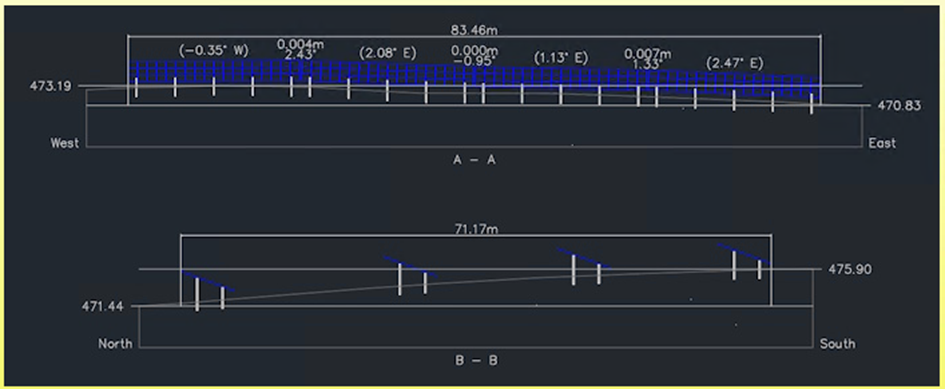
The resulting view shows the relationship between the PV tables, posts and terrain. It can be used to examine terrain-related height differences, table positions, post geometry and the distances between adjacent rows.
Cross section views are useful for layout reviews, constructability checks, technical documentation and communication with civil engineering, surveying and construction teams.
Cross Section Direction
The selected direction determines which objects and distances are represented in the cross section.
A cross section along a row shows the longitudinal development of the selected row in relation to the terrain.
A cross section perpendicular to the rows shows several adjacent PV tables and the terrain profile below them. This direction is particularly useful for reviewing table heights, module-to-terrain clearances and row-to-row distances.
Select a direction that crosses all objects required for the intended evaluation. If the section line does not intersect the relevant rows or terrain area, the resulting view may be incomplete.
Additional Dimensions and Annotations
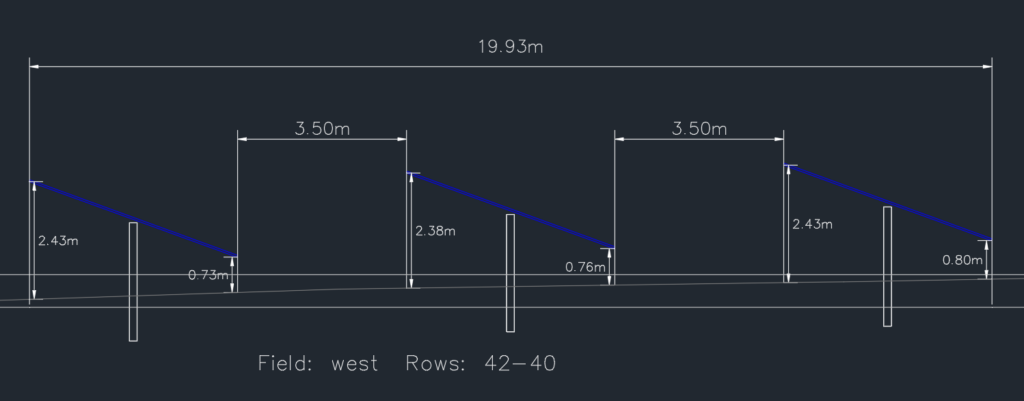
Cross section views can include additional dimensions for the distance between the modules and the DTM as well as the distances between adjacent rows.
These annotations make important layout clearances directly visible in the generated section and reduce the need to measure the corresponding distances manually.
Module-to-DTM Distance
The module-to-DTM annotation shows the clearance between the PV table or module geometry and the digital terrain model at the relevant position.
Use this dimension to review whether sufficient clearance is available between the modules and the terrain. This is particularly important on uneven terrain, where the available clearance can differ between the front and rear sides of a table.
The displayed value should be checked against the project requirements and the minimum clearance defined for the selected array system.
Row-to-Row Distance
The row-to-row annotation shows the distance between adjacent PV rows in the cross section.
Use this dimension to review the spacing of neighboring rows and to compare the resulting layout with the intended placement settings.
Depending on the terrain and the orientation of the rows, the displayed spacing in the cross section can help identify irregular distances or unexpected changes within the layout.
Dimension Style
The cross section function uses the dimension style H3D_CS.
This dimension style controls the appearance of the dimensions inserted into the cross section, including dimension lines, extension lines, text size and numerical formatting.
If dimensions are missing or displayed incorrectly, verify that:
- the dimension style
H3D_CSexists in the drawing; - the selected section direction intersects the required PV rows;
- the relevant PV tables and terrain data are available;
- the dimension text is not hidden by other drawing objects;
- the drawing scale and dimension settings are suitable for the generated view.
Do not replace or modify the H3D_CS dimension style without checking whether it is used by other cross section views in the drawing.
Checking the Cross Section
After creating the cross section, check that all required PV rows, posts and terrain elements are represented.
Verify that:
- the section follows the intended direction;
- the selected rows are included;
- the terrain profile is displayed;
- the module-to-DTM dimensions are available at the relevant positions;
- the row-to-row dimensions are complete and readable;
- the dimension values correspond to the visible geometry;
- dimension texts and lines do not overlap other annotations.
If the layout or terrain model is changed after the cross section has been created, check whether the existing section still represents the current project state. Create the cross section again if the displayed geometry or dimensions are no longer current.
Command Group Yield
The Yield commands support the evaluation of layout variants from an energy-oriented perspective. They do not replace a detailed external yield simulation, but they help to compare layouts and identify promising inclination and orientation settings during the planning process.
Run Yield Assessment

The yield assessment opens a dialog for evaluating the current layout based on calculation parameters and device values. It can be used to compare different layout alternatives and to identify which layout performs best under the selected assumptions.
Run Module Angle Optimization

Module angle optimization checks different module inclination angles and array orientations on a flat surface. The resulting report helps identify an ideal module orientation under simplified conditions. This makes the function useful for early design comparison and for understanding the influence of tilt and azimuth on expected power.
Important: The result is based on simplified flat-surface conditions. It should be reviewed carefully before applying the values to complex terrain, shaded areas or project-specific design constraints.